Home » The Complete Guide To Breast Cancer Treatment: What Everyone Needs To Know
reast Cancer is composed of a variety of tissues, from extremely fatty tissue to extremely dense tissue. There is a network of lobes inside this tissue. Each lobe is composed of lobules, which are tiny, tube-like structures that house milk glands. Milk is transported from the lobes to the nipple via tiny ducts that link the glands, lobules, and lobes. The areola, the darker region that encircles the nipple, contains the nipple in the center.
Healthy cells in the breast begin to alter and expand out of control to create a tumor, which is a mass or sheet of cells. A tumor may be benign or malignant. Malignant refers to the ability of a cancerous tumor to develop and metastasize to other bodily regions. A benign tumor is one that is still growing and has not yet spread.
Although breast cancer often progresses to adjacent lymph nodes, in which case it is still regarded as a local or regional illness, it can also spread through the blood vessels and/or lymph nodes to other parts of the body, including the bones, lungs, liver, and brain. This is the most advanced stage of breast cancer, often known as metastatic or stage IV. Stage IV breast cancer is typically not present if just local lymph nodes are involved.
Breast cancer comes in a variety of forms and can be divided into two groups: invasive and noninvasive. Breast cancer in situ is another name for noninvasive breast cancer. Noninvasive cancer doesn’t spread from the initial tissue, whereas invasive cancer does so from the breast ducts or glands to other regions of the breast.
The most typical kinds of breast cancer are divided into these two groups, and they include:
Ductal carcinoma in situ: DCIS, also known as ductal carcinoma in situ, is a noninvasive ailment. The cancer cells in DCIS are limited to the ducts in your breast and won’t spread to the nearby breast tissue.
Lobular carcinoma in situ: A lesion called lobular carcinoma in situ (LCIS) develops in your breast’s milk-producing glands. The cancer cells won’t invade the surrounding tissue, just like DCIS.
Invasive ductal carcinoma: Breast cancer of the most frequent form is invasive ductal carcinoma (IDC). This form of breast cancer starts in the milk ducts of your breast before spreading to surrounding breast tissue. Breast cancer can start to spread to neighboring organs and tissues after reaching the tissue outside your milk ducts.
Invasive lobular carcinoma: Initially forming in the lobules of your breast, invasive lobular carcinoma (ILC) later invades neighboring tissue.
The mass of the tumor and whether it has invaded the lymph nodes or other regions of the body are factors that a doctor considers when determining the stage of cancer.
Breast cancer can be staged in several different ways. Stages 0 through 4 are included below, and each stage has a subcategory.
Stage 0: Also referred to as ductal carcinoma in situ. The malignant cells have not progressed to the tissues around the ducts; they are contained solely inside.
Stage 1: The tumor can be up to 2 centimeters wide at this point. There are either no afflicted lymph nodes or a few cancerous cells in a few lymph nodes.
Stage 2: The tumor is 2 cm in diameter and has begun to spread to the lymph nodes nearby, or it is 2–5 cm in diameter but has not yet done so.
Stage 3: Either the tumor is more than 5 cm in size and has progressed to a few lymph nodes, or it is up to 5 cm in size and has progressed to more lymph nodes.
Stage 4: Cancer has advanced to distant organs, typically the lungs, liver, bones, or brain.
The types of therapies usually referred to as breast cancer treatment options for treating early-stage and locally progressed breast cancer are described below. The finest available therapies are referred to as “standard of care.” You are advised to consider the possibility of clinical trials with your doctor while deciding on a treatment strategy.Â
A clinical trial is a research project that evaluates a novel therapeutic strategy. Clinical trials allow physicians to determine if a novel treatment is risk-free, efficient, and perhaps even superior to the accepted practice. Here are some of the common breast cancer treatment options:
Chemotherapy is the use of medications to kill cancer cells, often by preventing the growth, division, and production of new cancer cells. It may be administered before surgery to minimize the size of a big tumor, facilitate surgery, and/or lower the chance of recurrence. Neoadjuvant chemotherapy is the name for it when it is administered before surgery. Additionally, adjuvant chemotherapy, which is administered after surgery to lower the chance of recurrence, may be used.
A typical neoadjuvant or adjuvant chemotherapy regimen, or schedule, consists of a mix of medications administered over the course of a certain number of cycles. Depending on what was most effective in clinical studies for that particular sort of regimen, chemotherapy may be administered according to a variety of schedules. It can be administered once per week, twice per week, or three times per week. Chemotherapy comes in a variety of forms that are used to treat breast cancer.
Chemotherapy for breast cancer is not always necessary for patients. Your oncologist could advise the best chemotherapy treatments for breast cancer depending on the stage of cancer:
Prior to surgery (Neoadjuvant Chemotherapy): Chemotherapy may be used to reduce a tumor. A less invasive procedure could be available if you choose this option. By observing how cancer reacts to chemotherapy, medical professionals may learn more about the biology of the disease.
After surgery (Adjuvant Chemotherapy): The presence of malignant cells in your body might occasionally go undetected by imaging examinations. To eradicate any cancer cells that may have survived the surgery, your doctor may advise chemotherapy. The likelihood of cancer coming back can also be decreased by this therapy.
Advanced Cancer: Chemotherapy may be the main treatment if your breast cancer has metastasized (spread to other places of your body).
IBC: The lump of inflammatory breast cancer (IBC) is difficult for a surgeon to readily remove. The first course of action for IBC is frequently chemotherapy.
Preparation For Chemotherapy For Breast Cancer
You’ll get blood tests a few days prior to your chemotherapy treatment. Based on your laboratory results and body mass index, your oncologist and pharmacist can customize your treatment using the information from the blood tests (BMI).
A central venous catheter (CVC) is a large, resilient tube that you could use to receive chemotherapy. A CVC will be surgically installed before therapy if your doctor advises it. Up until you finish chemotherapy, it remains in place.
Most patients who have breast cancer receive chemotherapy through one of their veins (IV). Chemotherapy can be administered intravenously or as a single brief injection. Longer-lasting infusions often occur in a hospital or specialized infusion facility. Your nurse will deliver your chemotherapy meds and any other medications you require after you arrive at the infusion facility. You could be given an anti-nausea medicine in addition to chemotherapy treatments, for instance.
Chemotherapy is often administered in cycles. You could have chemotherapy once per week, twice, three times, or even four times. Typically, cycles last for two to three treatments. There is a break between each cycle to give your body time to heal. For three weeks, you may, as an illustration, have the same therapy every Monday. The next week is additional for recovery before the cycle is repeated. Many patients receive therapy in several rounds. Three to six months may pass between treatments.
The type of medication you take and how long you take it will determine the adverse effects of chemotherapy. Typical chemo side effects include:
Â
Many people continue to work, exercise, and take care of their families while receiving chemotherapy. Others may find the therapy to be time- and energy-consuming. It could be challenging to continue with routine tasks.
The advantages and disadvantages of chemotherapy should be discussed with your healthcare professional. With the use of supporting medications, such as nausea meds, you can control side effects. In most cases, side effects from chemotherapy fade away once your treatment is through.
 High-energy x-rays or other particles are used in radiation treatment to kill cancer cells. Radiation oncologists are medical professionals that specialize in administering radiation therapy as a cancer treatment. Radiation therapy for breast cancer comes in a variety of forms:
External-beam radiation therapy: This sort of radiation therapy, which is administered from a machine outside the body, is the most popular. This covers both full and partial breast radiotherapy, as well as expedited breast radiotherapy, which might last a few days rather than a few weeks.
Intra-operative radiation therapy: This is when radiation therapy is administered in the operating room using a probe.
Brachytherapy: Brachytherapy for breast cancer is done by inserting radioactive sources into the tumor. Although intra-operative radiation treatment and brachytherapy are not often employed, the research findings are encouraging. They could be choices for a patient who has a tiny tumor that has not migrated to the lymph nodes if they are accessible.
Partial breast irradiation: Radiation therapy called partial breast irradiation (PBI) targets the tumor region specifically rather than the entire breast. After a lumpectomy, it occurs more frequently. The amount of time that patients must undergo radiation therapy is typically reduced by directing radiation directly to the tumor location. Only a select few patients, nevertheless, could be eligible for PBI. PBI is currently being researched, despite encouraging preliminary findings. However, it is already a standard of therapy in some situations, such as for some patients with early-stage breast cancer.
Intensity-modulated radiation therapy: An improved method of administering external-beam radiation treatment to the breast is intensity-modulated radiation therapy (IMRT). To more effectively target the tumor and distribute the radiation more uniformly across the breast, the radiation’s intensity is changed. The use of IMRT reduces the radiation dosage, which may reduce the risk of harm to neighboring organs like the heart and lungs as well as certain acute adverse effects like skin peeling during treatment.
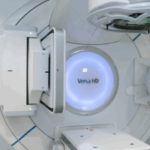
Proton therapy: X-rays, commonly known as photon therapy, are used in conventional radiation therapy for breast cancer to destroy cancer cells. A form of external-beam radiation therapy known as proton therapy employs protons rather than x-rays. Protons have the power to kill cancer cells at high energies. Different physical characteristics of protons might make radiation treatment more precise than photon therapy and possibly result in lower radiation dosage. The treatment could help cut down on radiation exposure close to the heart.
Fatigue, breast enlargement, redness or skin discoloration, and soreness or burning where the radiation was applied to the skin, along with blistering or peeling, are all possible adverse effects of radiation treatment. To alleviate some of these side effects, your doctor may suggest topical creams or lotions.
Rarely, radiation treatment can cause pneumonitis, a radiation-related swelling of the lung tissue, in a tiny portion of the lung. This danger varies according to the size of the radiation-treated area, and it usually goes away with time. You might be able to choose from a variety of radiation therapy options with various schedules. Discuss the pros and cons of each choice with your doctor.

The removal of the tumor during surgery, along with some nearby healthy tissue, is referred to as surgery for breast cancer. Under the arm, close-by axillary lymph nodes are also examined during surgery. A doctor who focuses on operating to remove the cancer is known as a surgical oncologist. More information on the fundamentals of cancer surgery
Whether you need medication-based therapy, such as chemotherapy, hormone therapy, and/or targeted therapy, is unaffected by the surgery you ultimately choose. It doesn’t matter what kind of surgery you undergo; pharmacological treatments are prescribed depending on the tumor’s features. The more surgical choices a patient has often depended on how big the tumor is.
Even though both lumpectomy and mastectomy are surgical procedures to treat breast cancer via surgery, they are very different from each otherÂ
Breast cancer or other aberrant tissue can be removed surgically through a procedure called a lumpectomy. A lumpectomy is a surgical operation in which the surgeon eliminates the cancerous or other abnormal tissue along with a small portion of the surrounding healthy tissue. This guarantees the removal of all aberrant tissue.
As just a piece of the breast is removed during a lumpectomy, it is also known as breast-conserving surgery or broad local excision. In contrast, all of the breast tissue is removed after a mastectomy. A quadrantectomy or excisional biopsy are other terms used by doctors to describe lumpectomies.
An option for treating early-stage breast cancer is a lumpectomy. A lumpectomy may occasionally be performed to rule out a cancer diagnosis. Radiation therapy is frequently administered to the breast after a lumpectomy procedure to lower the risk of the cancer returning.
A lumpectomy is a surgical procedure that removes cancer or other diseased tissue while leaving your breasts looking normal. The elimination of the entire breast (mastectomy) to treat early-stage breast cancer is not as successful in preventing a recurrence of the disease as a lumpectomy followed by radiation treatment.
If a biopsy reveals you have cancer and the tumor is thought to be tiny and in its early stages, your doctor could advise a lumpectomy. Several non-cancerous or pre-cancerous breast irregularities may also be removed via a lumpectomy.
In order to treat or prevent breast cancer, a mastectomy is a surgical procedure where the entire breast tissue is removed from the breast. A mastectomy could be a possible course of therapy for those with early-stage breast cancer. Another alternative is breast-conserving surgery, or lumpectomy, in which only the breast tumor is removed.
It might be challenging to choose between a lumpectomy and a mastectomy. For avoiding breast cancer recurrence, both treatments are equally beneficial. However, not everyone with breast cancer has the choice of having a lumpectomy; others would rather have a mastectomy.
Modern mastectomy methods allow for the preservation of breast skin and the restoration of a more natural-looking breast appearance. It’s also referred to as a skin-sparing mastectomy. Breast reconstruction surgery can either be performed concurrently with your mastectomy or at a subsequent procedure at a later time.
In order to avoid breast cancer, a mastectomy is suggested. If you don’t have breast cancer but are at a very high risk of getting it, you could also think about getting a mastectomy. Removing both of your breasts during a preventative (prophylactic) or risk-reducing mastectomy greatly lowers your chance of later getting breast cancer.
Only individuals with a very high risk of breast cancer—determined by a strong family history of the disease or the presence of certain genetic abnormalities that raise the risk of breast cancer—are eligible for a preventative mastectomy.
While receiving hormone therapy for breast cancer, you will visit your oncologist frequently for check-ups. If you are suffering any adverse symptoms, your oncologist will inquire. Many adverse effects are controllable.
In patients with early-stage hormone-sensitive breast cancers, hormone treatment after surgery, radiation, or chemotherapy has been demonstrated to lower the chance of breast cancer recurrence. It can also successfully lower the chance of developing and spreading hormone-sensitive breast cancers in persons with the disease.
Depending on your scenario, you may be subjected to tests to keep an eye on your health and look for cancer development or recurrence while receiving hormone treatment. Your doctor may change your treatment based on the results of these tests to see how you are reacting to hormone therapy.Breast Cancer – The Complete Guide To Breast Cancer Treatment


Designed by Acmeinfolabs